1998
This is a study in the sociology of philosophy. It can be regarded as a branch of what is commonly known as the sociology of knowledge. The difference between them is this. Whereas sociology of knowledge considers the beliefs of groups of people, sociology of philosophy restricts this to the beliefs of philosophers, or the impact of the beliefs of philosophers on others. Some sociology of philosophy is included in histories of philosophy and in the biographies of philosophers. However, the first and only study ~ of sociology of philosophy, using statistical data, of which I am familiar, was done by Pitrim Sorokin, a sociologist at Harvard. His findings are presented in vol. 2 of his four volume Social and Cultural Dynamics: Fluctuations of Systems of Truth, Ethics, and Law (New York: The Bedminster Press, 1937.
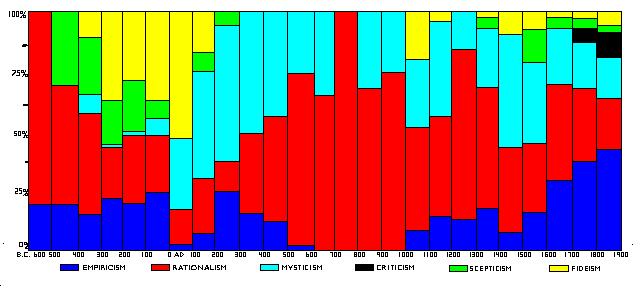
With the collaboration of two Russian philosophers: Lossky and Lapshin, he devised a set of criteria, and a scale of 1-12 to represent the influence of particular philosophers, and they proceeded to scour through the literature of the history of Western philosophy to determine various tendencies. Their results were represented in a number of tables and charts. I have included one of their charts, titled "Fluctuations of the Influence of Systems of Truth (by Centuries)", as an example of their findings.
Partially inspired by Sorokin's quantitative approach, I have done a statistical survey of the 100 most influential philosophers of the past 50 years. By "influential" I simply mean whether their views were taken into consideration by other philosophers. So this is a study in the influence of philosophers on other philosophers. Now, to do this sort of study would require going through the philosophical literature and determining what philosopher or philosophers are being discussed. Fortunately this task is made somewhat easier by the existence of computer data banks. My research tool was the Philosopher's Index on CD-ROM. Presently, the Philosopher's Index references close to 300 periodicals, including articles and book reviews. It includes a retrospective indexing of periodicals back to 1940.
One can search the Philosopher's Index by different categories. For my purposes, the most suitable category, which was to determine the influence of a philosopher on other philosophers, was the category "named person." On my understanding of "influence", a philosopher is influential if he or she is discussed -- regardless of whether it is positively or negatively; so the category of "named person" is exactly to the point.
The Philosopher's Index is not geared for the kind of search which I was conducting, so the process is not completely automated ~ in fact it required a lotof tedius work of recording numbers. When the idea of undertaking this project hit me, I had no hint of what numbers were large or small, so I arbitrarily decided to write down all entries that had 50 or more hits for "named person". I then sorted this data in a descending order the result is Table 1. This represents the total times the philosopher was indexed as "named person" from 1940-1997, in all the languages covered; which includes the dominant languages of English, French, German, Italian, and Spanish.
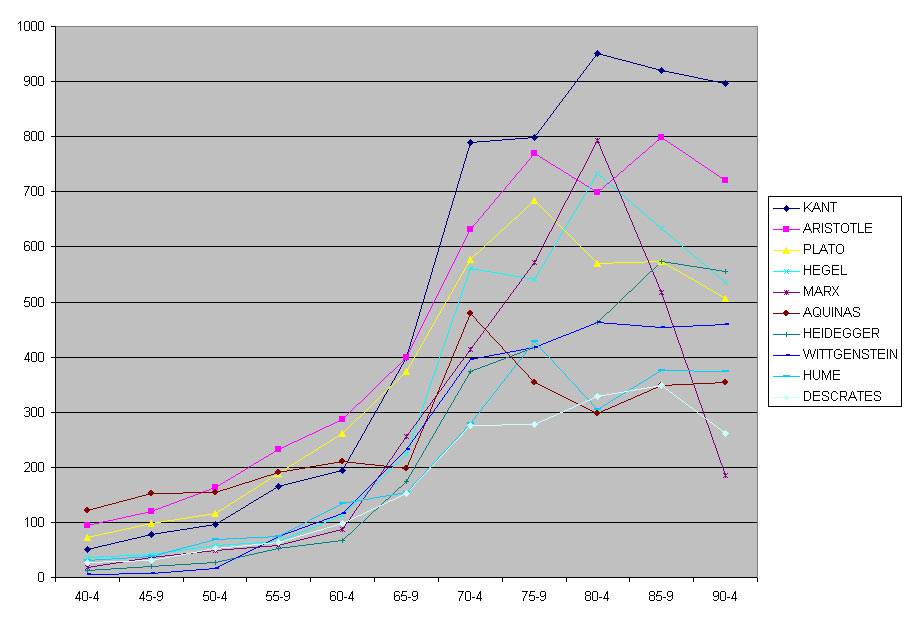
Well this data gives us an idea of who are the dominant philosophers of the last 50 years, but it doesn't give us any indications of fluctuations, which would be of interest in understanding past and current trends. To get at the. finer grain, I decided to get the statistics for 5 year periods. This is given in Table 2. Here we get a picture of the rise and fall of the number of times a philosopher is indexed as a "named person".
I should point out a numerical discrepancy. The sum total of "named person" by 5 year periods never adds up to the number obtained by doing a simple search for "named person". The reason for this is that sometimes the year of a publication is not given ~ so these publications are not taken account of when doing searches by years. Most of these deviations were small ~ however some were noticeably higher. However, I have not determined whether such omissions are significant.
I should also point out something which may be misleading. The number of publications has been steadily increasing; so, low numbers in 1940 may appear insignificant. However, if we were to plot these numbers in terms of percentages of publications, the charts would take a totally different look. For example, in 1940-4 the dominant philosopher was Aquinas, and if the chart were presented in percentages of publications — his stature would be even greater than that of Kant in the 1980-4 period.
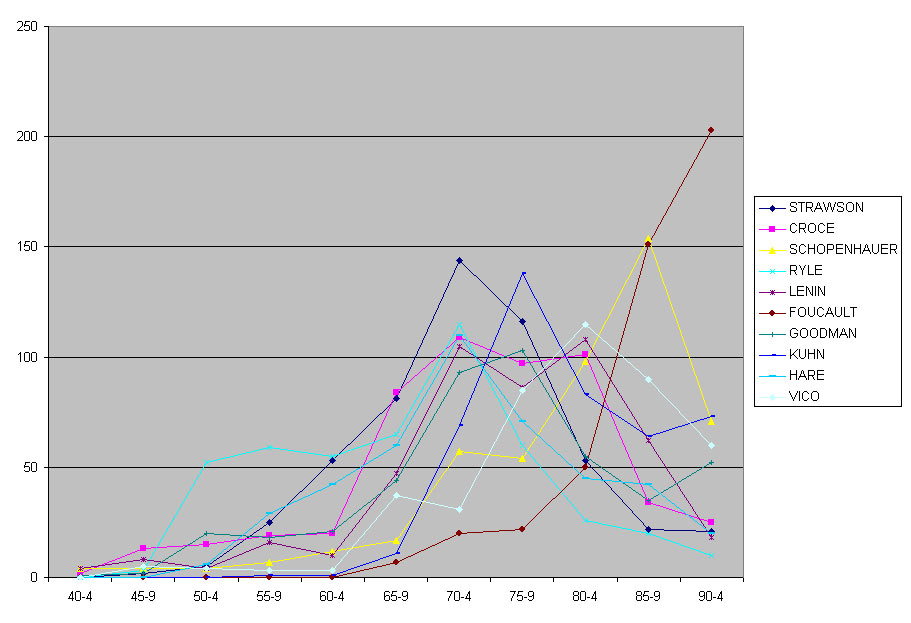
Another precaution, these charts have different scales. These should be taken into account. For example, in the 1990-4 period, Nietzsche ranks above Wittgenstein ~ but this sort of information is best gleaned from the tables rather than the charts. Also do not be mislead by the low numbers in the 1995-97 period ~ remember this represents a 2 year period, in contrast to the 5 year periods; however, one can still appreciate the relative standing of philosophers in this period.
2
Fluctuations of the Influence of Systems of Truth (by Centuries): This is an example of Sorokin's study in the sociology of philosophy.
Table 1: A descending list of philosophers who had 50 or more entries in the Philosopher's Index for "named person" for the period 1940-Sept. 1997.
Table 2: A descending list of the top 100 philosophers from Table 1, divided by 5 year periods (except for the 95-97 period).
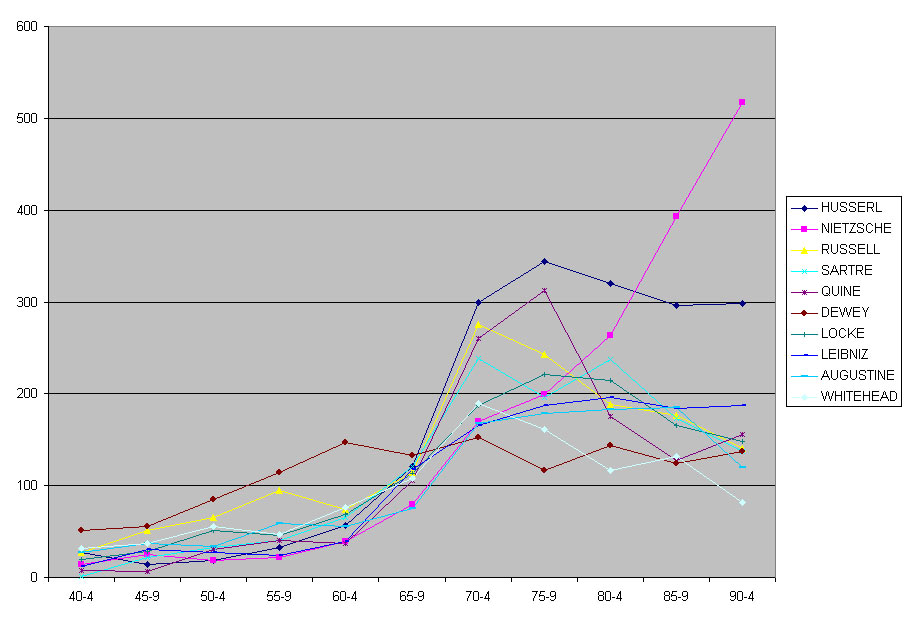
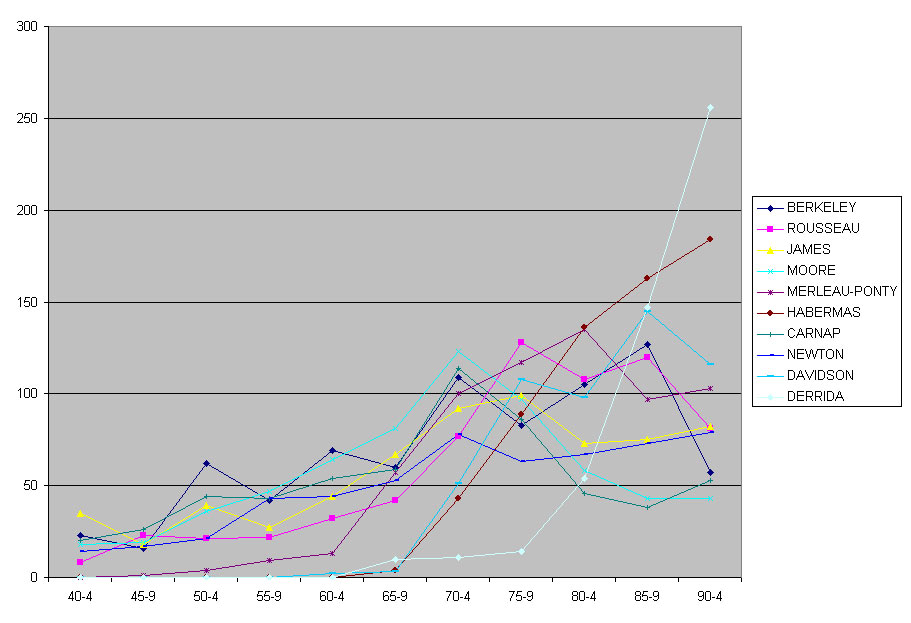
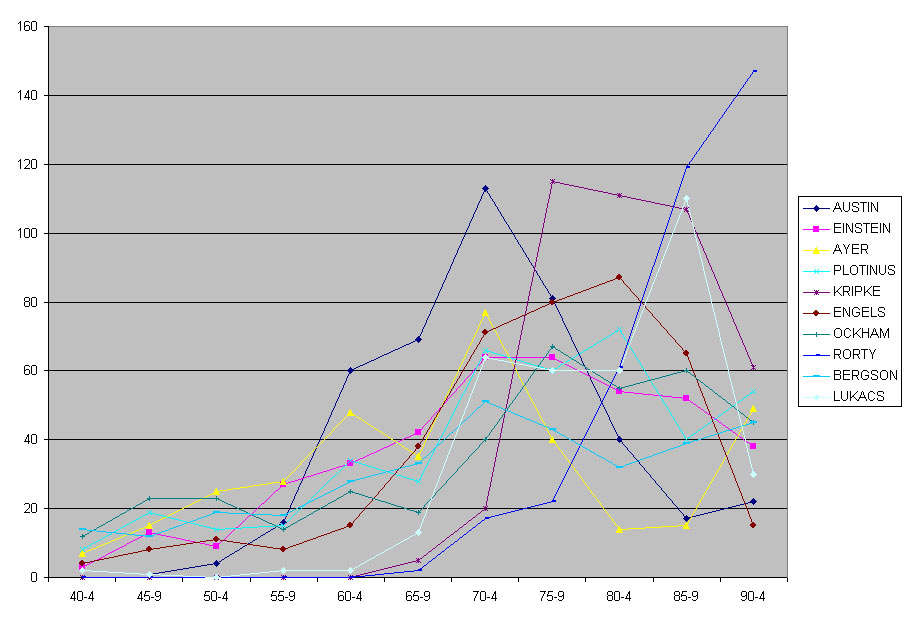
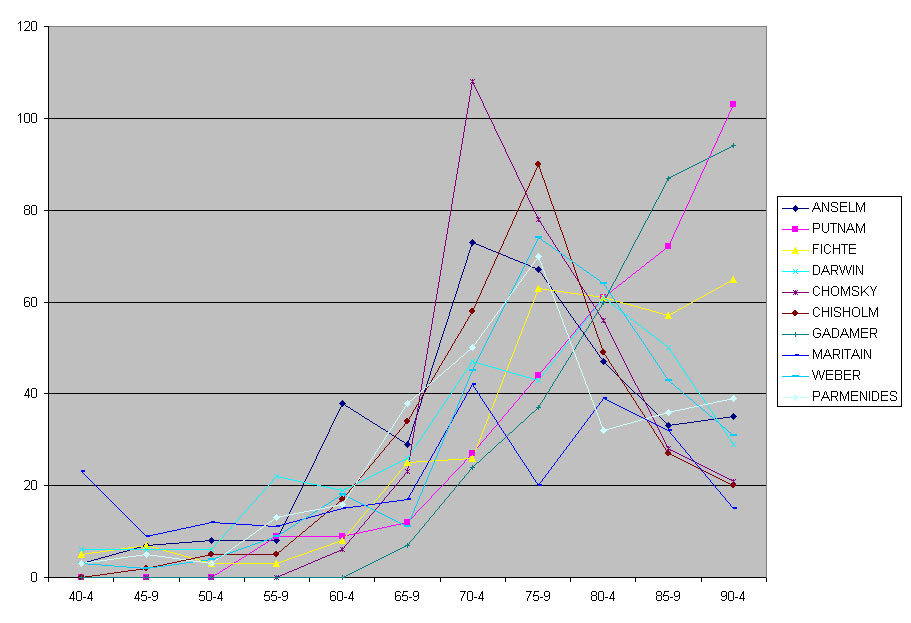
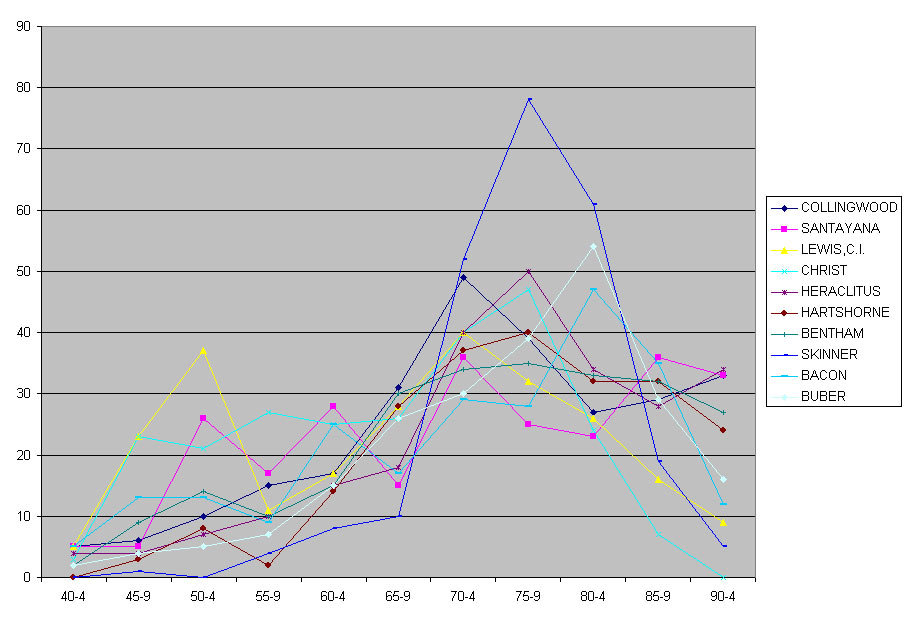
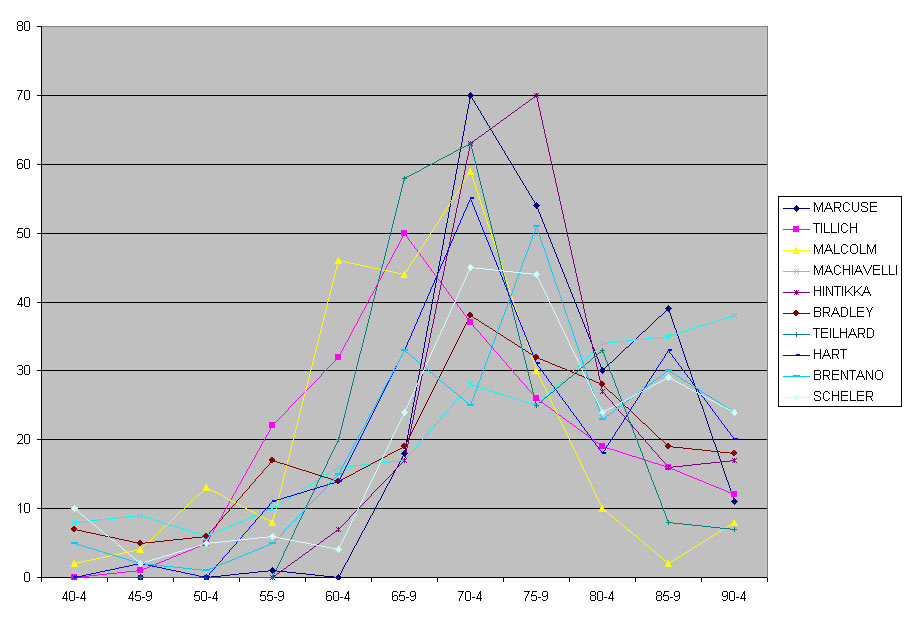
Charts 1-10: The figures from table 2 are graphed by 10 philosophers each.
Table 3: This is a list of the top 100 philosophers (from Table 1) broken down into the number of occurrences of named person in the five major languages (relative to philosophical publications): English, French, German, Spanish, and Italian.
Charts 11-20: The figures from table 3 are graphed by 10 philosophers each.
Table 4: A descending list of the top 100 philosophers from Table 1 in the English language, divided by 5 year periods (except for the 95-97 period).
Charts 1B-10B: The figures from table 4 are graphed by 10 philosophers each.
Number of Articles: This is a chart of how many articles in philosophy were indexed by the Philosopher's Index yearly, 1940-1997.
Number of Articles Published: This is a table and chart of how many articles in philosophy were indexed in the Philosopher's Index by 5 year periods from 1940-1997 ~ comparing totals with those in the English language.
These observations are about Charts 1-10.
Chart 1: The dominant philosopher in the world since about 1965 has been Kant, followed by Aristotle, who was dominant in the 1950-65 period. Note the dramatic rise of Marx and Hegel, peaking in 1980-4, and the subsequent dramatic decline of Marx. Aquinas, who ranked first in 1940-4, and peaked in 1970-4, is now in 8th position. Heidegger's influence has been steadily rising, and since about 1990 he has ranked 3rd in overall standings.
Chart 2: Most of these philosophers peaked in 1970-4, except for Quine and Popper,
3
who peaked in 1975-9. Husserl is showing a moderate ascent. And there is no way to mistake the spectacular rise of Nietzsche.
Chart 3: Kierkegaard appears to be ascending, while everyone else seems to be declining after peaking ~ except possibly Peirce.
Chart 4: Note the dramatic rise of Habermas and Foucault, and the meteoric ascent of
Derrida.
\
Chart 5: Lenin seems to share the fate of Marx. Analytic philosophers, like Strawson and Ryle, seem to have peaked in 1970-4, and are now on the decline. Fichte is the only philosopher in our charts who is showing an ascent in the 1995-97 period ~ a two year period; this is equivalent to some kind of explosion in Fichte interest, which began around 1990.
Chart 6: Rorty is on a prominent ascent. Austin, another analytic philosopher, peaked in 1970-4 and is in a rapid decline. Kripke rose very suddenly in 1975 and kept his place till 1990, when he started to decline. Putnam is on a definite rise.
Chart 7: Schelling, Gadamer and Ricoeur are on steep ascents. Searle seems to be getting a second rise. Lukacs after rising in 1970, maintained his status, shot up in 1985, and in 1990 had a sharp decline. Maritain peaked in 1970-4 and subsequently has had a moderate decline.
Chart 8: Chomsky and Hempel peak in 1970-4 and then abruptly decline. Chisholm peaked in 1975-9 and is now declining. Nozick peaked in 1980-4, and is now on a decline. Levinas, after a steady ascent, has definitely risen in 1990-97.
Chart 9: Piaget peaked in 1980-4 and is now on a decline. Whereas Hintikka peaked in 1975-9 and declined, there is a sign of a moderate resurgence. C. I. Lewis peaked in 1950-4 and again in 1970-4, and is now declining. Machiavelli seems to be on the rise.
Chart 10: Skinner peaked in 1975-9 and has had a very dramatic decline. Adorno and Lonergan peaked in 1990-94. David Lewis peaked in 1975-9, and then experienced a slight decline; but in 1990-4 he has risen even higher than in 1975-9. Marcuse peaked in 1970-74, and has now taken a nose dive. Christ, who peaked in 1975-9, has since 1990 had no entries.
Remember this is a descriptive, sociological study -- not a normative one. Let us not confuse influence and popularity with importance. For example, some of the philosophers who I consider important didn't even make the charts.
Below are 10 charts representing the standing of the philosophers who were ranked 1-100.
| 1-10 |
|
| 11-20 |
|
| 21-30 |

|
| 31-40 |
|
| 41-50 |
|
| 51-60 |
|
| 61-70 |
|
| 71-80 |

|
| 81-90 |
|
| 91-100 |
|
