CHAPTER II
THE SETTLER BUYS ON CREDIT
The advent of Jeffersonian Democracy, contrary to expectations, did not bring revolutionary changes in national land policy. In the same year that Jefferson aided in drawing up that liberal document, the Declaration of Independence, he averred that
"the people who will migrate to the westward . . . will be a people little able to pay taxes. . . . By selling the lands to them, you will disgust them, and cause an avulsion of them from the common union. They will settle the lands in spite of everybody, -- I am at the same time clear that . . . [the lands] should be appropriated in small quantities."1In the later years of the Revolutionary period Jefferson more than any other person had been responsible for the democratic changes in the Virginian land system. Throughout the Federalist period of the 1790's, while many of the nation's great men and his own colleagues were engaged in land speculation, he consistently maintained his opposition to aristocratic tendencies in political economy. It would seem, then, that personally Jefferson was probably in favor of drastic changes in the national land system. But the responsibilities of the presidency appear to have moderated any revolutionary tendencies in that direction. To do away with the revenue system in the disposal of public lands would have brought strong repercussions regarding the rest of his program. Besides, little was to be gained by encouraging more rapid expansion of the frontier which was already seething with discontent and constantly threatened by danger of Indian wars if not foreign war. In retrospect it appears that Jefferson's contribution to the problem transcended mere details to set for federal land policy a new and more democratic course.
As Hamilton brought strength to his party by teaching infant industries the art of politics, so Jefferson built up his following by teaching the principles of a modest agrarian imperialism. Jefferson was confident that more land and not less land would save the American people from what seemed to him the pitfalls of Hamilton's industrialism. He saw clearly that possession of the great valley of the Mississippi meant more to the agricultural interests of the country than any other gift of mankind. This Virginia philosopher, exponent of economy and strict construction, may have experienced trouble with his conscience, but it is certain that "We, the people of the United States" experienced unbounded and pleasurable astonishment when it was announced in 1803 that the United States had gurchased Louisiana. The addition of 756,961,280 acres of land to the public domain at a cost of 3.6 cents per acre2 was one of the greatest bargains ever struck off by the hand of man. It secured to the United States the greatest and richest valley of land in the world, which when filled with a hardy and free population would guarantee the perpetuity of American democracy throughout the years to come.
As one examines the undercurrents of the westward movement it is evident that Jefferson was the instrument for carrying out a step which economic forces had already conditioned.3 At any rate, the treaty of 1803 gave official encouragement to the process by which Americans, insatiable in their quest for more land, carried American authority to the shores of the Pacific Ocean. Economic control of the Mississippi Valley came first, then a step over into West Florida, a misstep in the direction of Canada, and finally, a definite move against East Florida. By these short steps the principle of paramount interest and the doctrine of a modest agrarian imperialism added many broad acres to the public domain in the period, 1803 to 1820.4 The purchase of Florida from Spain in 1819 -- 37,931,520 acres at a cost of 17.1 cents per acre -- climaxed the first period of westward extension.
In less conspicuous fashion the same process operated against the American Indians. While Jefferson professed the most benevolent principles toward the aborigines,5 nevertheless he coveted their lands for the expansion of the white man's arcadia. The Treaty of Greenville of 1795 brought to an end a period in which the Indians for the most part had taken the offensive; the inauguration of Jefferson opened one in which the Americans assumed the offensive.6 Between 1795 and 1809, the Indians of the Northwest were rounded up by government officials and plied with oratory and whiskey until they had signed away their rights to forty-eight million acres of land. This procedure was primarily responsible for the Tecumseh revolt of 1811 which merged into the War of 1812. In 1814 the Indians of the Northwest found themselves deserted by their British allies. By 1820 the armies of General Harrison and General Jackson had removed the Indian menace east of the Mississippi River. Indian title to much of the Southwest was extinguished by 1818, to the southern half of Indiana by the so-called New Purchase of 1817, and to all of Illinois by 1819. Considerable inroads had also been made into lands held by Indians in other parts of the public domain.
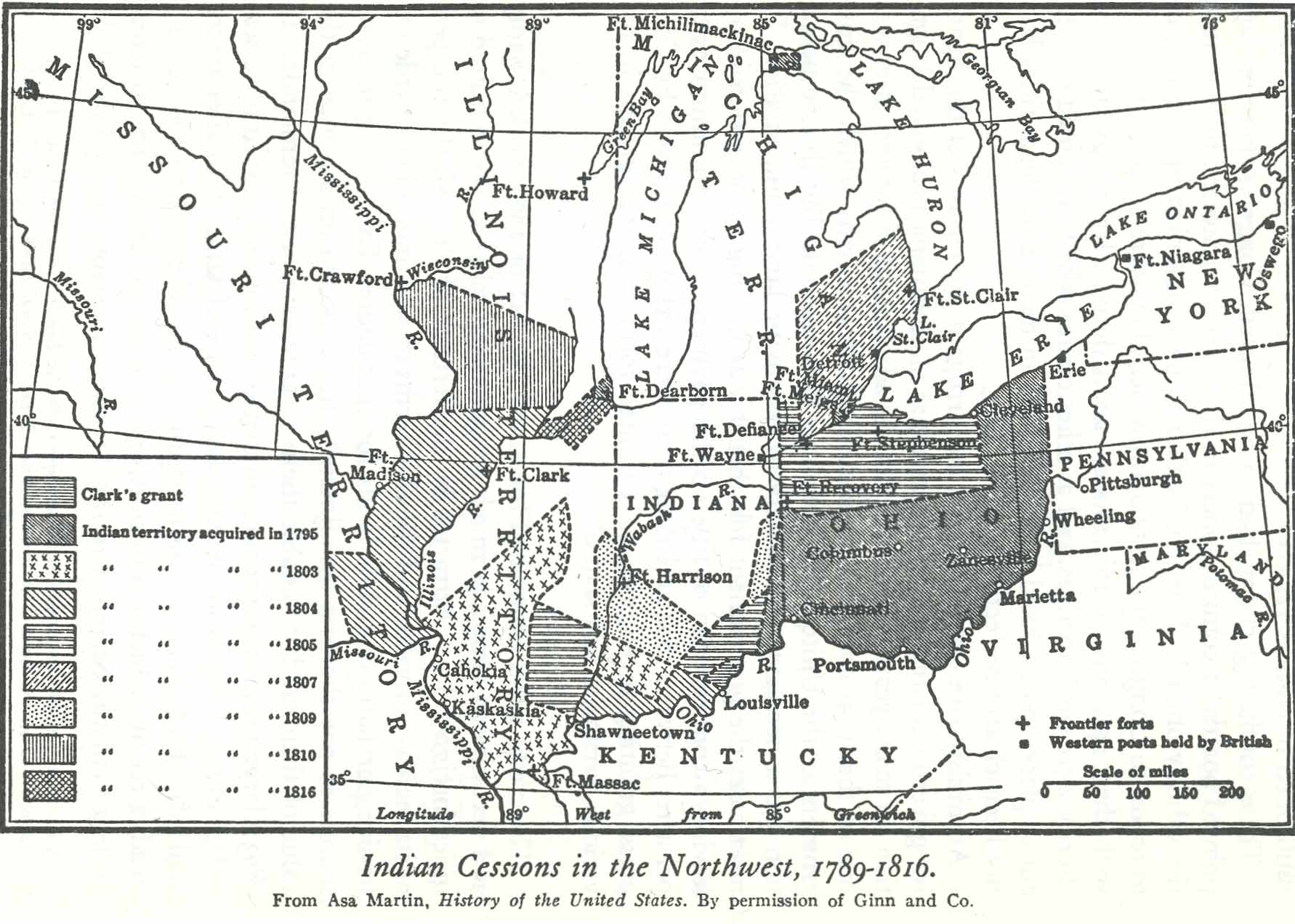
Coincident with the purchase of Louisiana and the admission of Ohio into the union as the first public-land state there developed an-other period of speculation. This time the speculation involved lands of the public domain, and while it resulted in some significant settlement, it was nevertheless frought with much evil. "To such an extent," declared a frontier newspaper, "had the hateful spirit of inordinate speculation in lands proceeded, that it had corrupted the fountains of legislation and the courts of justice, as well as the body politic. The rapacious spirit of accumulating large bodies of land, pervaded the whole country and nation, engendering a mass of corruption in every state of the Union; and . . . menaced the existence of the Union itself."7
This outburst of speculative enterprise was due for the most part to two factors: the existence of claims to land based on foreign, title, and the credit system established by the Act of 1800. Various claims were advanced to tracts either by right of occupancy under the laws of the United States, or by virtue of grants made by England, France or Spain before the territory passed to the United States. The Spanish authorities in the Louisiana territory before 1803 acceded to overtures and collusions for the purpose of personal aggrandizement. Lynx-eyed speculators eagerly sought claims of this character and soon an active commerce sprang up between the artful land-jobbers and the docile, unlettered settlers, with the result that titles, complete and incomplete, multiplied in endless variety.
These conflicting claims had to be adjusted. Congress therefore appointed boards of commissioners in the several territories, to look into the validity of such claims and either to pass judgment upon them, or to report to Congress the facts upon which they were founded together with their opinions. In this mode, claims derived from legitimate authority were confirmed, as well as ether claims which it seemed expedient to place upon a fixed basis, although in many cases legal titles had not been clearly perfected.
Administrative difficulties and the arrogant pretensions of the Spanish government relative to the purchase of Louisiana prolonged litigation for many years. Without doubt the adjustment of foreign titles was one of the most complicated administrative problems which the government of the United States has ever encountered.8 But this adjudication was a necessary preliminary to systematic land administration. In most cases the government felt that it was making a concession in allowing a confirmation of title on the payment of the minimum price per acre. Between 1804 and 1830, there were sixteen acts passed by Congress, granting preemption in a limited form to special groups in the various territories and states.9
The credit system provided for under the Act of 1800 worked badly and necessitated almost as much congressional relief as was required to quiet foreign titles.10 Attracted by the fertility of the soil, the prospect of its increase in value and the easy terms of sale, individuals made extensive purchases of public lands for speculation. Exhausting their resources to pay the first installments, they expected an advance in the value of their lands to enable them to take care of the remainder. In 1803 a large number of petitions presented to Congress prayed for essential changes in the land system, such as sale of land in smaller tracts, abolition of all charges of interest upon these sales, selling for cash instead of credit, reduction of prices, and granting of small tracts to actual settlers. Gallatin, Secretary of the Treasury, therefore advised the abolition of the credit system, proposing in its place reduction of the minimum price from $2 to $1.25, and sale in small tracts of 160 acres. In the Act of 1804 Congress reduced the minimum cash price to $1.64 per acre, and the minimum amount to a quarter section, but refused to alter the credit system.11 As for those settlers who could not meet their payments, the government chose to grant them relief rather than allow them to forfeit their lands. After 1806, in fact, relief acts came to be passed almost as regularly as annual appropriation bills.
Meanwhile the timeworn problem of intrusions on public lands continued to press upon Congress. Petition after petition begging for relief through preemption came from western squatters who knew that they would lose their holdings at the auction. The public lands committee of the House of Representatives reported in 1801 a typical petition of certain persons who "with much labor and difficulty" had "settled upon, cultivated, and improved certain lands, the property of the United States between the waters of the Scioto and Muskingum rivers," and had thereby "not only enhanced the value of the lands" upon which they had "respectively settled, but of the lands in the vicinity of the same, to the great benefit of the United States."
The signers prayed for "a preemption right to those lands at $2 per acre, and such credit as Congress" thought "proper to extend to them, clear of interest." To these petitioners the congressional committee offered sympathy but, feeling that there were many other settlers in the same predicament, it decided that "granting the indulgence prayed for would operate as an encouragement to intrusions on publie lands, and would be an injustifiable sacrifice ot the public interest. . . . The prayer . . . [therefore] ought not to be granted."12 In 1806 the public lands committee declared that "when it is considered that these individuals settled without authority, or any reasonable ground of expectation from the government, it is evident that any hardships to which they may be exposed are chargeable only to their own indiscretion."13
To cope with the lawlessness of these backwoodsmen Congress adopted stringent legislation. As early as 1802, John Randolph introduced a bill to prevent intrusions on the public domain.14 Not until 1807, however, did Congress seriously take up this matter. The Intrusion Act, passed in that year, admitted in its very terms the inability of the government to administer the law. It provided that unlawful settlers could become tenants at will until they were able to pay for their land or until someone else bought it. But if the intruder on public land did not register his tenancy he was subject to a six months' imprisonment" and a fine of one hundred dollars. The frontier army was to imprison settlers who did not conform to these regulations. But inasmuch as the frontier army was made up mainly of frontiersmen, including many squatters, it is not clear just how Congress expected the law to be enforced. This act was a typical example of eastern ignorance of western conditions. It was partially repealed seven years later, although much of it remained on the statute books for decades.15
In spite of the multifarious and complex problems which the government faced, the westward march of settlement continued. In fact, it threatened to depopulate Connecticut, and the legislature sought means of alleviating the "Ohio fever." One observer said: "Young people in their plays at social gatherings marched to rude melodies which taught them to dream that toward the setting sun lay an earthly paradise with gates open to welcome them. From hill and valley the processions hurried away."16 Washington Irving described in his Legend of Sleepy Hollow Ichabod Crane's desire to marry the fair Katrinka Van Tassel and with her dowry to purchase the supplies, oxen and covered wagon necessary for the trek west. This is a contemporary delineation of the Connecticut Yankee's urge "to go West" -- to the Holland Purchase in western New York, by way of the "Pittsburgh Pike" to the public lands of Ohio, or by the Buffalo gateway to the fertile plains of the Western Reserve.17
In the Southwest, however, the competition of state lands was sharp, and few settlers were attracted onto the public domain, Kentucky was selling 400-acre tracts on a liberal installment plan at 25 cents an acre, and Georgia was disposing of her lands under a lottery system at a nominal price of 6 or 8 cents an acre.18
On the whole, the government of the United States was more lenient than its laws would lead one to believe. Its generosity reached out in many directions. While with one hand it tried to prevent speculation and illegal settlement, with the other it was ready to help the settlers out of their difficulties. In addition to the legislative relief already noted with respect to foreign titles and land indebtedness, a great amount of land was doled out by the government, in the period 1800 to 1820, as compensation for military and naval services, in grants, for asylums for the deaf and dumb, in donations to religious organizations, for the benefit of sufferers in the New Madrid earthquake, for the encouragement of the growth of vine and olives, etc.19 But even this benevolence dwindled into insignificance when compared with the broad grants made for public advancement, for schools and for internal improvements.
When Ohio, the first public-land state, was admitted into the union in 1803, the federal government adopted the policy of retaining title to all land within the state boundaries, excepting one section in each township which was set aside for a state fund for common schools. In addition, 3 per cent of the net proceeds of the sales of public lands were earmarked for building roads.20 Such allowances were made on condition that the state, county, or township should not levy taxes on the land sold by the United States for five years after the sale.21 This Ohio precedent guided policy for every public-land state later admitted to the union. Had the states of the Old Northwest handled their school grants wisely, they would have aided considerably the support of local schools, but too frequently careless and sometimes corrupt legislatures hastily sold the lands and improperly invested the proceeds.22
The last important event in the history of public land administration during this period occurred on the eve of the outbreak of the war with Great Britain. In 1812, a General Land Office was established in Washington as a bureau of the Treasury Department,23 and a commissioner took over the duties formerly performed by the Secretary of the Treasury. This arrangement lasted until 1849 when the Land Office was transferred to the newly created Department of the Interior.
With the outbreak of the War of 1812, westward migration slumped and land sales ceased. But soon after the return of peace in 1814 the movement revived and shortly expanded to incredible proportions. Like a mountain torrent it poured thousands of settlers onto the fertile lands of the Mississippi Valley. This Great Migration, as it was called, was a movement of peoples comparable to the barbarian invasions of Europe in the fourth century, but unlike those invasions it consisted for the most part of a native population moving out of the eastern states.
A number of events prepared the way for this exodus. The Louisiana Purchase, the Burr Conspiracy, the Yazoo Company speculations, the Lewis and Clark and the Pike expeditions, the expanding interests of the fur trade and the campaigns of the War of 1812 -- all advertised the West. Continued discussion of a system of internal improvements linking the East and the West, the beginning of construction of the National Road, the fight in New York state over the possibilities of an Erie canal, the opening up of steam navigation on the Ohio and Mississippi rivers -- these factors also pointed the way to a great western boom. In the East conditions were never more propitious. The rise of the factory system in New England, the falling off of commerce, and the disbanding of the armies in 1815 had contributed to produce for the first time in the history of the American economic order a considerable oversupply of labor. Since the best of the eastern state lands were now taken up, there was nothing apparently to alleviate the situation but a movement onto the public domain of the transappalachian West where land could be purchased on credit.
Towns grew and villages sprang up over night. Mt. Pleasant, a little Ohio hamlet of seven families before the war, grew in 1815 to a town of five hundred souls boasting seven stores, three taverns, a meetinghouse, a schoolhouse, a market house, and within a radius of six miles, nine merchant mills, two grist mills, twelve saw mills, a paper mill, and a factory for woolen cloth.24 When cotton rose to 30 cents a pound in 1816, and to the unprecedented price of 34 cents two years later, people poured into the virgin wilderness of the Southwest like the swirling eddies of rushing waters. Lands still stained by the blood of Indian wars sold at prices as high as $50 or even $100 an acre.25 The Reverend John Peck, a traveller of the period, declared that the pioneers poured into Missouri faster than it was possible to provide corn for breadstuff. "It seemed as though Kentucky and Tennessee were breaking up and moving to the 'Far West'," he declared. "Caravan after caravan passed over the prairies of Illinois, crossing the 'great river' at St. Louis all bound for Boone's Lick."26
Six frontier states were admitted into the union between 1816 and 1821, of which all but Maine were public-land states. Over a million acres of public land were sold in 1814, and by 1818 the figure had climbed to the three-and-a-half-million mark. The population of Ohio increased from 230,000 in 1810 to 400,000 in 1816, and to 581,295 in 1820. That of Indiana rose from 24,000 in 1810 to 70,000 in 1816, and to 147,178 in 1820. Illinois had acquired a population of 55,162 by 1820. Alabama in 1818 counted 45,000 whites and 21,000 slaves, while Missouri in 1820 had 56,000 whites and 10,200 slaves. In 1820 Indiana could boast a 600 per cent increase of population in ten years. Illinois showed 350 per cent; Missouri, 215 per cent; Mississippi, 89 per cent; Tennessee, 68 per cent; Ohio, 50 per cent, and Kentucky, 39 per cent. As Professor Turner aptly put it, "A single section had arisen and was growing at such a rate that a description of it in any single year would be falsified before it could be published."27
In Missouri the zeal to purchase land amounted to a fever. Another traveller, Timothy Flint, recorded that "land speculators constituted a particular party. It required prodigious efforts to become adroit. The speculator[s] had a peculiar kind of slang dialect . . . and when they walked about it was with an air of solemn thoughtfulness upon their countenance[s] as though wisdom would die with them. The surveyors of course were very important instruments in this business, and a great and fortunate land speculator and landholder was looked up to with as much veneration by the people, as any partner in the house of Hope in London or Gray in America."28
Bounty land warrants originally granted by the government for military service brought severe strictures upon the government. The West felt much dissatisfaction at throwing open land for the location of these warrants. Doubtless feeling would have been less strong if the soldiers themselves had taken possession of the land so generously bestowed, but military scrip was transferable and considerable amounts of it had been bought up by speculators. It was claimed, for instance, that the right to 320 acres in central Indiana was purchased for $17.50 and sold for $5,000.29
This "monster," speculation, fixed its eager grasp upon some of the best lands in the West and held them for a rise in prices. Everywhere, especially in Alabama, lands were selling at advances out of all proportion to their actual value.30 Throughout the length and breadth of the frontier the cry went up against the speculator. The situation was due to the "disgrace of our legislation, which grants every facility to the rich without consulting the poor," declared a contemporary authority on the subject.31
While the speculator waxed fat on milk and, honey in the new West, the actual serttler did not fare so well. Many settlers had invested in lands on credit hoping to pay out of the increase in the value of their holdings or out of its produce. Some were able to do so but many were not. The continual introduction of new lands into the market diminished the value of those that were already purchased. The importation of merchandise from the eastern seaports drained the West of its money, and the products of the newer regions however abundant could command only low prices because of the lack of means of transportation. All the capital that could be procured was sufficient for the improvement of but a small portion of the land already purchased. In truth, much of the public domain which the government had sold to actual settlers remained in a state of primeval wilderness.
The relief problem inherited from the period before the War of 1812 became even more pressing during the period of inflation following the year 1815. The only cure for land indebtedness seemed to be the granting of more relief to the debtors, and so Congress passed relief act after relief act. Attempts to bring about forfeiture of the settlers' interests because of non-payment generally brought forth public outcry. Forfeited land offered at auction often went at prices lower than those in the settler's contract. In some regions the force of public opinion was such that no one would bid against the original claimant, and in most of such cases he was permitted to re-enter his land.32
An estimate submitted in 1816 to the House of Representatives showed that land sold at the auctions, most of it to men of money, brought only ten and a half cents more than the minimum price per acre.33 The government had already disposed of 212,000 acres of land to actual settlers at bargain prices under special preemption legislation. The question arose whether it would not be better to allow all settlers a general preemption and thus provide for actual settlement than to sell to speculators who merely held lands for higher prices. This would solve the land-indebtedness problem to some extent. But rather than make such a radical change the national government persisted in following the policy of 1800.
The Second United States Bank established in 1816 did not succeed, as its founders hoped it would, in checking bank inflation, which was prevalent especially in the West where state banks were established in wholesale lots for the precise purpose of manufacturing credit to be used in buying land and constructing internal improvements.34 An attempt in 1817 to require payment for public lands in specie served only to increase the numbers of persons buying on credit.
Regardless of the failure of Congress to stem the tide of inflation, economic laws were taking their course. In the laws of speculation like those of gravitation, all that goes up must eventually come down. In the latter part of 1816 a sudden reduction in prices in the Atlantic states and the failure of many banks in the western country pointed to catastrophe ahead. As long as land prices remained high and emigrants continued to arrive bringing money to buy, as long as there was an abundant and unnatural circulation of money, both good and spurious, speculation and rising values continued. But the moment the pressure began to prevent people from selling their lands, the tide began to ebb.
No sooner was the bubble pricked and panic burst upon the country than public opinion turned against the moneyed interests and consequently against the national government. The western country joined wholeheartedly in criticizing the Bank of the United States. And a general hatred of banks appeared which was to result finally in political action.35 The hard times following the Panic of 1819 did much to produce the wave of democratic sentiment which swept eastward out of the Mississippi Valley under the leadership of Andrew Jackson. A Kentucky newspaper declared that land speculation was the sole cause of the depression in the West, "the most portentous evil that ever existed in America; it threatens the dissolution of the union."36
The truth is that both the speculator and the actual settler were responsible for this unhealthy condition in the national land system. The liberal credit features of the Act of 1800, while leading to much settlement in the West, nevertheless played an important part in bringing on the Panic of 1819.37 A report of the Secretary of the Treasury in 1819 revealed the starting truth that since 1789 the government had sold land to the value of forty-four million dollars, but had received as yet but half of this sum.38 Between 1815 and 1819 the amount of money owed the government increased from three million to seventeen million dollars.39 In view of the prostrate conditions existing throughout the country and the hatred that was arising against the creditor interests, the government was compelled at last to take steps to put its house in order. Thorough revision of the land laws was essential to a more orderly and systematic settlement of the public domain, but such alteration would necessarily involve the abrogation of credit -- the very life blood of the West.
Western newspapers suddenly grasped the significance of any change in the land system. Every possible atom of praise for the existing system was sought out by western interests and broadcast to the countryside. The editor of the National Intelligencer, speaking of the land system of the United States, eloquently declared that
"so wise, beautiful, and perfect a system was never before adopted by any government or nation on earth. In regard to rights of man, and dignity, and happiness of man, it triumphs over the legislation of Europe and laughs at the barbaric pomp of Asia. . . . No other country or age has produced a land system so sublime in principle, so perfect in practice, so magnificent in prospect. . . . The titles to land . . . are derived from the public authority, whose arm is extended to maintain the rightful possession.. . . The banner of freedom which waves over the whole proclaims the character and protective power of the United States. . . . Greece in its wisdom, Rome in its grandeur, Europe in its glory, never realized a system so deserving the admiration and applause of human-kind."40State legislatures were quick to support public opinion. The legislatures of Indiana and Louisiana drew up memorials praying that no change be made in the land laws, and describing the injurious effects such change would have on the western country.41 Many eastern business interests, particularly the rising manufacturers and the enterprising builders of canals, turnpikes, and railways, roundly denounced any alteration of the existing system.42
The Senate of the United States took the initiative in the matter. Ninian Edwards of Illinois who led the opposition preferred confirming the sale of public lands to actual settlers. "Can it be a dictate of wisdom," he asked, "to predicate a general system upon a particular and extraordinary case which is gone by, and in all probability will never again occur? Can it be wise to select that moment for abolishing all credit upon the sale of public lands when money is scarcer than it has ever heretofore been, and thereby retard settlement of those lands at the very time when the state of things which produced the supposed evils of the credit system is rapidly disappearing?"43 But the efforts of Edwards and other frontier leaders were of no avail; the reform bill became a law on April 24, 1820.
The Act of 182044 lowered the minimum price of land to $1.25, required full payment in cash, and reduced the minimum amount that could be purchased to eighty acres.
Thus closed an era in the settlement of the public domain. Jeffersonian Democracy had opened the fight for the disposal of western lands to actual settlers, rather than to speculators and proprietors. The credit system may not have brought much money into the national treasury, but the settlement of the West was of incalculable value to the country. The abolition of the credit system was for the moment a blow to the settlers, but some consolation could be found in the provisions of the Act of 1820 which reduced the minimum price to $1.25 an acre and the minimum amount of land which the government would sell to eighty acres.
The cash-payment requirement, however, benefited the speculator at the expense of the settler. It deprived the latter of the advantage which the installment plan had heretofore given him in bidding against speculators at the auction. Competition with men of money for choice tracts of land would henceforth be difficult unless wildcat banks should come to the rescue. American settlers however had already learned the art of turning well-intentioned laws to their own purposes. Profiting by past experience, they immediately initiated a crusade to democratize the land system -- to give all men an equal opportunity to acquire land. What the settlers lost through the operation of the credit system they would regain in the next twenty years through the success of the preemption movement.