2. The manifest world is primarily a world of things, animate and inanimate, and persons. Things belong to kinds which are characterized by clusters of powers, capacities, dispositions and propensities, or -- to use a general term intended to cover all these, and more -- causal properties. The causality involved is both immanent and transeunt. The paradigm of the former is the lawful development of a closed system; of the latter, the interaction of two sub-systems.
3. The essential feature of causal properties is their "iffyness" -- their analytic connection with subjunctive conditionals. Thus, for an item to be water soluble is for it to be such that, ceteris paribus, if it were in water it would be dissolving.
4. Philosophers have often made use, explicitly or implicitly, of a categorial distinction between iffy or conditional properties, of which solubility is a prime example, and what might be called pure occurrent1 properties, i.e., properties which, although they may be connected with other properties by subjunctive conditionals, do not consist, as does solubility, of properties which play the antecedent and consequent roles in a subjunctive conditional, thus coming to be in water and dissolving.
5. It is a familiar story that this tidy distinction between iffy and non-iffy properties has many problematic features, particularly when it comes to finding examples. Compare the task of finding convincing examples of negative properties. These problems are of a piece with that of finding a use for the abstract distinction between statements which are true by virtue of explicit definitions and statements which are true as a matter of empirical fact.
6. Now these specific problems lie outside the scope of this lecture. But since I shall attempt to draw other well-defined distinctions, some methodological cards must be laid on the table.
7. Thus I shall assume, without argument, that philosophical insight is gained, essentially, by confronting discourse about man-in-the-world with tidy, if provisional, conceptual models which we understand because we have constructed them. I shall not, however, attempt to explain the nature of this confrontation -- other than to say that it generates the philosophic dialectic -- nor how it makes possible the desired insight.
8. I shall content myself with the reflection that few would take strong exception to the general thesis, and with the sobering thought that the question as to the specifics of how philosophy achieves its goal must still wait on the achievement.
9. Merely to evoke the protean messiness of natural language makes no valid point against the use of well-defined models. Only those who assume the antecedent reality of these models are legitimate targets for this ploy.
10. It is analytic of the dialectical method that the tidiness of conceptual distinctions is as such no ground for rejecting them. (That tidiness is, as such, a mark of the provisional is the other side of the coin.) For it is only in terms of a more embracing set of well defined distinctions that they can effectively be challenged, and a more articulated (but still provisional) model achieved.
11. If, therefore, I assume that the tidy distinctions referred to in the opening paragraphs are sound, it is because I suspect that much of the clamor against them amounts to little more than a pseudo-dialectical challenge to the partisans of clarity and distinctness that they pull the leviathan of finished truth out of the ocean of natural language. (Compare Diogenes' challenge to Plato to point to one of his Forms.)
12. I shall shortly be shortly exploring alternatives to the regimented framework of things and persons which I have been adumbrating. But first I must introduce the central topic of this lecture, that of process.
13. The objects of the manifest world change. They are involved in events or happenings. Of course, many of them, much of the time, are stodgy. Whether or not an object is changing, it endures. Endures, that is to say, as long as it exists. For, typically, these objects come into being and pass away.
14. Thus Socrates came into being and passed away. He was also involved in events. Many of the events in which he participated were very complex, and he participated in them along with others. Some were relatively simple, thus the event of Socrates running on a certain summer day in such and such a year. Other objects were clearly involved, but relatively to the manner in which I have referred to it, their role is implicit.
15. The first thing to note, as we approach ontological issues is that there are two ways in which one can express this historical fact about Socrates:
(1) by a simple subject-predicate sentence (with an adverbial modifier),
(2) by a counterpart sentence, the subject of which is an event expression
| A running by Socrates at t |
took place is taking place will take place |
16. I propose to construe this relationship as akin to that between
(3) Snow is whiteand
(4) Being white is exemplified by snowand to apply to (2) the type of analysis I have given of (4).
17. The topic of abstract entities is notoriously difficult and controversial. There is no time on the present occasion to be anything but brief and dogmatic. Yet if I cannot elaborate and defend the analysis, I can at least attempt to formulate it as clearly as possible. That this will involve oversimplification is, alas, unavoidable.2
18. Roughly put, the gist of the analysis is that the depth grammar of (4) is, in the first instance,
(41) That it is white is true of snowand, in the second instance,
(42) 'x is white' is true 'snow'/'x'
which tells us, in the regimented language of a grammatical theory, that sentences consisting of an appropriate singular term concatenated with 'is white' are true in case the singular term in question is 'snow'.
19. According to this analysis, then, abstract singular terms formed by the use of such suffixes as 'ity', 'hood', and 'ness', and by such prefixes as 'that' -- as in 'that snow is white' -- and 'being' -- as in 'being white' or 'being triangular' -- are natural language quoting devises.3
20. It should also be noted, for future reference, that quoted expressions, thus
'and'are not to be construed as names. Their surface grammar is, indeed, that of a singular term, as is shown by the fact that they are appropriately followed by a verb in the singular, thus
'and' is a conjunctionBut their depth grammar is that of a distributive singular term formed from a sortal, as 'the (a) lion' is formed from 'lion'. Thus, just as
The (a) lion is tawnytells us that
lions. normally, are tawnyso
The (an) 'and' is a conjunctiontells us that
'and's (normally) are conjunctions.
21. The application of the above strategy to event expressions is reasonably straightforward. Thus,
A running by Socrates is taking placeis to be reconstructed, in first approximation, as
'Socrates runs' is trueand
The coronation of George VI took placeas, in first approximation,
'George VI is being crowned' was trueand, in second approximation (cf. paragraph 20)
'George VI is being crowned's were truewhere the distributive singular term which occurs in the former has been cashed out into the corresponding general term.
22. This analysis, however, omits the uniqueness condition, by virtue of which 'the coronation of George VI' resembles 'the present king of France'. To capture it we must postulate the presence in the depth grammar of an adverbial modifier such as 'once and only once'. Thus a closer approximation would be
'George VI is being crowned for the first and only time' was true.
23. On this interpretation, 'takes place' and 'occurs' are construed as alethic predicates -- predicates definable in terms of truth. In this respect they belong in the same family as 'exemplifies'; for according to the above line of thought,
Tom exemplifies being tallis to be construed as
That he is tall is true of Tomi.e., in first approximation,
x is tall' is true 'Tom'/'x'and, in second approximation, cashing out the distributive singular term,
'x is tall's are true 'Tom's/'x's
24. Other examples of alethic predicates pertaining to events are 'performed' and 'participated in'. Thus
Socrates performed a runningbecomes
That he runs was true of Socratesi.e.,
'x runs' was true 'Socrates'/'x'and
Jones participated in a robberybecomes
That he and others jointly robbed a third party was true of Jonesi.e.,
'x and others jointly robbed a third party', was true 'Jones'/'x'
25. But I am not attempting in this lecture to give a systematic exposition of a theory of event locutions, let alone to defend it against putative counterexamples. I shall simply argue that if something like it is true, interesting light is thrown on ontological topics pertaining to time and process.
26. One of the first points to be noticed and stressed is the tensed character of alethic predication in event contexts. Thus, where 'E' represents an event locution, and 'M' its metalinguistic counterparts we have the equivalences summed up by the following schema
| E | took is taking place will take place |
| M | was true is true will be true |
27. I have argued elsewhere4 that tense -- in that broad sense which includes both tensed verbs and such indicator words as 'now' -- is an irreducible feature of temporal discourse. In other words, the temporal aspects of the world cannot be captured by discourse from which all 'tensedness' has been eliminated. I shall not reargue this thesis which, after all, is widely held, on the present occasion. I shall simply take it to be an essential part of the larger story I am trying to tell.
29 With a qualification to be considered in the next section, talk about events is a way of talking about things changing. Thus there are no events in addition to changing things and persons.
30. Another, but closely related, ontological point: There are no temporal relations. The key to this point is the fact that relation words are predicates, and are completed into atomic sentences by singular terms, thus
a is next to b.
31. Predicates can be construed as open sentences; but not every open sentence is a predicate. Obvious examples are
... or ___if ..., then ___
32. Consider, now, certain expressions which are often taken to stand for relations, namely 'before', 'during', 'after', 'while', as in
Socrates ran before he dinedor, to use the example with which I first made this point,5
Nero fiddled while Rome burned.
33. The expressions which flank 'before' and 'while' in these examples are not singular terms, but sentences.6
34. In the passage referred to in note 5 above, I characterized the above expressions as 'temporal connectives' to emphasize that like the logical connectives they are not relation words. I now think it better to construe them as adverbs, and await an adequate theory of adverbial modifiers for further illumination.7
35. Notice that items other than relations can exhibit features which are characteristic of relations, thus transitivity, asymmetry, reflexiveness, and the like. Consider
a is taller than b
b is taller than c
Therefore, a is taller than cIf p, then q
If q, then r
Therefore, if p then rS1 Vd before S2 Vd
S2 Vd before S3 Vd
Therefore, S1 Vd before S3 Vd
36. In the third syllogism, 'before' exhibits transitivity, although it does not stand for a relation.
37. So far I have discussed the functioning of such words as 'before' in contexts in which they are flanked by such sentences as 'Nero fiddled' and 'Rome burned'. What if we turn our attention to contexts which involve event expressions?
38. Let us turn our attention, therefore, from the sentence
Socrates ran onceto the event expression
The running by Socrates
39. If we seize upon the idiomatic
The running by Socrates was before the dining by Socrateswe might reason as follows. This sentence has the surface form
(singular term) was before (singular term)therefore it is prima facie proper to construe before in this context -- unlike that of
Socrates ran once before he dined-- as a relation.
40. But if the strategy outlined in paragraphs 18-22 is correct, this surface grammar is misleading. The idiomatic sentence in 39 must be replaced by the more perspicuous
The running by Socrates took place before the dining by Socrates took place.
41. Two comments are in order: (1) -- and most important -- this time 'before' is again flanked by sentences rather than singular terms. (2) The singular terms 'the running by Socrates' and 'the dining by Socrates' not only do not flank 'before', they are surface transforms of general terms.
42. The situation is best represented by the sequence -- in the later stages of which the uniqueness condition is ignored --
The running by Socrates was before the dining by SocratesIn the concluding formulation both sources of the original construal of 'before' as a relation word have disappeared, and its role as a temporal connective made manifest.The running by Socrates took place before the dining by Socrates took place
That he runs was true of Socrates before that he dines was true of Socrates
That Socrates runs was true before that Socrates dines was true
'Socrates runs' was true before 'Socrates dines' was true
'Socrates runs's were true before 'Socrates dines's were true
43. Thus even in the context of explicit event expressions 'before" remains a temporal connective.
44. From this perspective relational theories of time -- taken seriously as such -- involve a category mistake, as does the ontology of events -- the 'objects' introduced to serve as the terms of temporal 'relations' -- which it requires.
45. What we need is a temporal connective theory of time. But this is a goal which can only be adumbrated on the present occasion.
47. We have been dealing with event expressions formed from sentences about changing things. We have been construing expressions of the form
The Ving of Sas metalinguistic transforms of sentences of the form
S Vs8
48. We now need to note the existence in the manifest framework of verbs which take dummy subjects. Consider
It rainsIn the case of rain it is not difficult to find an equivalent (though not necessarily synonymous) sentence which has as its subject as unproblematic referring expressions, thusIt thunders
It lightnings
Rain rainedIn the other cases this is more difficult. We might tryDrops of water fell
Thunder thunderedBut whereas we could ostensibly cash out 'rain' in terms of 'drops of water', in these cases there seems to be no available referring expressions which have a sense independent of the verbs which are to be predicated of them. We might tryLightning lightninged
A sound thunderedBut these seem to raise the same problem all over again, for we are simply moving from the specific to the generic -- from, for example, 'thunder' to 'sound'. We want to understand such noun expressions asA flash lightninged
a soundas well as such sentences asa flash
There was lightningThere was a clap of thunder
There was a sound.
49. Instead of addressing this topic directly, I shall sidle into it by considering the account of the processes expressed by these verbs which was offered by a philosopher who has thrown as much light as anybody on problems pertaining to time.9
50. Broad introduces the concept of what he calls 'absolute processes', -- which might also be called subjectless (or objectless) events. These are processes, the occurrence of which is, in the first instance, expressed by sentences of the kind we have just been considering, i.e., which either do not have logical subjects or which have dummy logical subjects.
51. In other words, the sentences which give them their primary expression do not have the form
S Vs, e.g., Socrates runsnor can plausible paraphrases which have genuine logical subjects be found.
52. Notice that 'electrons jumped across the gap' is not to count as, in the desired sense, a paraphrase of 'there was lightning'. We must distinguish between the questions:
Can all statements which are ostensibly about absolute processes be paraphrased in terms of changing things?Granted that some can not, can the absolute processes to which they refer be explained in terms of changing things?
53. To give a negative answer to the first question is to grant the existence -- in the manifest image -- of absolute processes. To give an affirmative answer to the second question would seem to commit one to the availability in principle of a scientific account of the world in which all processes are 'reduced', in the sense in which kinetic theory 'reduces' heat to molecular motion, to processes with subjects.
54. Needless to say, to commit oneself to the latter idea is compatible with holding that in some other sense of 'reduce', processes with subjects can be reduced to subjectless processes.
55. Indeed, it might be argued that two theories might have the same factual content -- whatever exactly this means -- and yet one have the 'grammar' of changing things, the other that of absolute processes.
56. All of these questions -- and more -- are clearly buzzing around our heads when we begin to wonder about the relative merits of 'substance' ontologies and 'process' ontologies (to say nothing of 'mixed' ontologies). But these questions do not, as yet, have any clear sense. Still more ground work must be laid.
57. Clearly the first step must be to get a better grip on the concept of an absolute process by considering some ostensible examples.
58. Thus, following Broad, let us consider sounds. Here it is essential to distinguish between the object which produces the sound and the sound produced. To take a well worn example; a bell, when struck by its clapper, produces a familiar kind of sound.
59. When the bell tolls, it produces a sequence of sounds. The tolling of the bell belongs to the framework of events examined in the preceding sections. We are now concerned with the 'grammar' of the sounds produced.
60. In the manifest image, the volume of pink which is the perceptible core of a pink ice cube is an item out there in the environment which is pink in the occurrent sense. It is also pink in the dispositional sense -- it has the power to bring about experiences of a cube of pink in standard observers in standard conditions. But the primary sense in which pink occurs is not that in which experiences of pink occur.
61. Similarly, the sound produced by a middle C# tuning fork is a middle C# sound. Like the volume of pink, it is out there in the environment. It 'comes from' the tuning fork, and successively 'pervades' concentric regions of space. It is a C# sound in the occurrent sense. It is also a C# sound in the dispositional sense -- it has the power to bring about experiences of a C# sound in standard observers in standard conditions. But, again, the primary sense in which C# occurs is not that in which experiences of C# occur.
62. When the tuning fork sounds, it does so by producing a sound. The sound produced is a process of a specific kind.
63. Now it is characteristic of processes that we speak of them in terms of verbs. Consider a sound of the buzzing kind. Do we mean by the latter phrase the kind produced by a buzzing -- where 'buzzing' refers to the activity, for example, of a bee in a way which is conceptually independent of the intrinsic character of the process produced by the buzzing? This is most implausible.
64. It is more plausible to suggest that 'to buzz' in the sense in which we predicate it of bees stands for the kind of activity which produces a characteristic kind of sound -- which can also in another, but related, sense be said to be a buzzing. (We might, using an Aristotelian locution, say that buzzing, like healthy is said in many ways.)
65. This line of thought suggests that what is primary in the various senses of the verb 'to buzz' is the concept of the intrinsic character of a certain kind of process which can be identified in terms of its typical causes. The verb 'to buzz', then, would have a sense in which processes of that intrinsic kind would be buzzings, even when they were not being brought about by one of these typical causes.
66. Thus, in this sense of the verb 'to buzz' we could say that a buzzing is going on without implying that some object, e.g. a bee, is buzzing.
67. We are now in a position to zero in on a key question. What would be the relation between this sense of the verb 'to buzz' and the sortal phrase 'a buzzing'? Consider the two sentences,
There is a buzzing (coming from) over thereWhich is, 'primary'? Is there any point to picking one out as primary?It buzzes (from) over there
68. To switch back to our original example, and, using for simplicity the preposition 'in' rather than the more complicated spatial locutions we have found to be appropriate, consider the sentence,
There is a C# ing in the cornerOstensibly this has the form
(Ex) x is a C#ing and x is in the cornerWhat is the range of the variable 'x', and how are the predications to be understood? Let us beat about in the neighboring fields.
69. Processes, like tragedies, have beginnings, middles and ends. In the case of absolute processes we can speak of absolute coming to be and ceasing to be, because when a sounding, e.g., a C#ing, begins, there is nothing which begins -- in the relevant sense -- to sound. (Compare 'sound' in the sense of 'produces sound'.)
70. When, on the other hand, a running begins, it is because someone begins to run.
71. Broad points out10 that absolute processes can, in a perfectly meaningful sense, be said to change -- meaningful and intelligible, but not easily analyzed. Consider the following situation:
The sounding began as a C#ing. It gradually became higher in pitch until it was an Eb ing. It then suddenly changed into (was followed by?) an Fing.How do we individuate soundings? Relevant considerations are continuity, spatial location, causality --thus, suppose that the successive stages of the sounding described above came from a single tuning fork with variable pitch.
72. We noticed above that
a running begins <--> someone begins to run
We were not reminded, however, that while this equivalence obtains, it does not constitute an identity of sense. For if our original analysis is correct
a Ving beganwhere 'V' is a verb which takes a proper subject, is to be understood as
That it began to V was true of somethingi.e. (where 'INDCON' represents an appropriate category of individual constants)
'x begins to V' was true INDCON/'x'
73. In other words we must take into account the fact that according to that analysis, 'running' as an event sortal is a metalinguistic nominalization of 'to run', as 'being red' is a metalinguistic nominalization of 'is red'.
74. We argued, therefore, that while, of course, there are events, there really are no events, for events are not basic items -- atoms -- in the furniture of the manifest image. This claim was supported by two lines of thought: (a) we can always retreat from statements which involve event locutions, and which ostensibly make a commitment to a domain of events as objects in the world, thus
A running by Socrates took placeto statements which do not, thus
Socrates ran.
75. (b) Since (a), by itself, is compatible with the claim that it is events, rather than things, which are primary, the dominant consideration was, according to our analysis, that event locutions belong one step up the semantic ladder and refer to linguistic or conceptual items, rather than to items in the world.11
76. At this point, parity suggests that we construe the phrase 'a C#ing' as a metalinguistic nominalization of the verb 'to C#' as we have construed 'a coronation' as a metalinguistic nominalization of 'to crown or be crowned'.
77. A strong consideration in favor of making this move is the fact that 'a C#ing' fits as snugly as does 'a coronation' into the context
. . . is taking placeand its cousins '. . . is going on', and '. . . is occurring'. Here also these alethic predicates would take metalinguistic subjects.
78. If we make this move, then
A C#ing is taking place in the cornerwould have the same general forrn as
A coronation is taking place in Londonand if the latter has the depth grammar
That someone is crowning someone there is true of Londoni.e.,
'Someone is crowning someone in x' is true 'London'/'x'the former would have the form
That it C#s there is true of the corneri.e.,
'It C#s in x' is true 'the corner'/'x'
79. If so, then in the sense in which coronations are only ostensible objects -- as contrasted with crowns, bishops and Kings -- so C#ings would be only ostensible objects . . . as contrasted with what?!
81. The alternative I have in mind takes its point of departure from the logical atomisms of the 20s and 30s, when the impact of Principia Mathematica on the supersaturated state of philosophy seemed to many to precipitate out the very structure of the world.
82. Logical atomism is essentially an ontological perspective. It has implications for epistemology and semantics, but they do not concern us here.
83. The atomist asks us to consider a domain of basic objects -- basic in the sense that they are non-composite, having no actual as opposed to virtual, parts. All other objects are wholes which consist of these 'atoms', which are, in the mereological sense, their 'parts'.
84. The ontological intuitions of the atomists are not easy to make concrete by means of examples. They present a regulative ideal which serves as a bed of Procrustes on which putative examples are pulled into shape.
85. It will be sufficient for our initial purposes to follow the lead of the neutral monists, who sought to eliminate metaphysical and epistemological puzzles by reducing all objects to patterns or complexes of sensibilia. Their slogan might well have been: Of course there are minds and material things. But there really are no minds or material things; for neither minds nor material things are among the ultimate constituents -- sensibilia -- of which all things are made.
86. In effect, they proposed that we view the statements in which we describe the manifest world of changing things as capable of correlation with logically complex statements in a language of which the basic statements ascribe qualities and relations to sensibilia.
87. Roughly, statements of the form
S is a Kwhere 'S' refers to changeable things and 'K', 'P' stand for kinds, properties and activities of changeable things, would be correlated with statements (needless to say, of enormous complexity) of which the individual variables range over sensibilia, and of which the predicate stands for qualities of and relations between sensibilia.S is P
S is V
88. The story is a familiar one. I evoke it only to make the point that the subjunctive dimension of the conditional properties of the objects of the manifest image would be correlated with lawlike truths involving patterns of basic objects, thus,
If there were to be a pattern, Pi, at s, t there would be a pattern, Pj, at s', t'
89. Basic objects would not have basic properties of the form
If x were f, x would be yand the basic kinds of the framework, unlike those of the manifest image, would not have such properties as their criteria.
90. Notice, however, that basic kinds might very well have subjunctive criteria -- these, however, would concern uniformities in the co-occurrence of basic objects of certain kinds with basic objects of other kinds.
91. There would, so to speak, be no potentialities in basic objects.
92. A final point, for future reference, before we put this 'alternative' framework to use. The correlations of which we have been speaking between statements in the two frameworks need not be viewed as offering analysis of manifest statements, i.e., as preserving sense.
93. As a not unrelated point, it should be noticed that to 'identify' manifest water with volumes of H2O is not to analyze statements about water into statements about H2O.
94. Nor is it (more than superficially) to establish a correlation between manifest water and its observable properties on the one hand, and H2O and its theoretical properties on the other.
95. It is rather to say that the one framework is, with appropriate adjustments in the larger context, replaceable by the by other -- eliminable in favor of the other. The replacement would be justified by the greater explanatory power of the new framework.
96. Logical atomists might similarly claim that the correlations of which they speak are to be viewed as a possible replacement of the manifest image by a framework having the ontological texture of their regulative ideal. This replaceability (in principle) would be justified by a concilience of metaphysical considerations.
98. If we now view C#ings in the light of our envisaged neutral monism, we might be tempted to say that even if C#ings are not objects proper, nevertheless the larger framework does, at least, include such genuine objects as
rectangular expanses of redand
cubical volumes of pink
99. If, however, we take the, at first sight12 radical step of construing all the "atoms" of our neutral monist model as absolute processes, we begin to be puzzled indeed.
100. Thus, if we make this move, expanses of red would be (to use a word coined by John Wisdom in the early 30s) reddings. Thus
There is an expanse of red over therewould point to
It reds over therejust as, according to the account given in Section IV above,
There is a C#ing in the cornerpoints to
It C#s in the corner
101. Indeed
There is a rectangular expanse of red over therewould point to
It rectangularly (!) reds over therefor the former's (noun modifier)-(noun) structure is being construed as a transformation of a depth structure in which what is modified is the verb 'reds', and in which the modifier is, therefore, in the broad grammatical sense, an adverb.
102. We suddenly see that the world we have been constructing is one in which every basic state of affairs is expressed by the use of verbs and adverbs.
103. The idea has fascinating implications. Indeed, we have in barest outline a truly heracleitean ontology.panta rei. There are no objects. The world is an ongoing tissue of goings on.
104. Needless to say, the concept of an ontology without objects is; as the term ontology is currently used, an incoherent one. But perhaps it is our concept of ontology which needs to be revised.
105. Of course a platonist (or neo-pythagorean) like Quine can always console himself with the idea that ontology as currently conceived is not empty, because there are abstract objects -- sets, sets of sets, and so on without end. And other ontologists will rejoice in their platonic Forms -- the domain of attributes, propositions, and possible worlds without end.
106. But those of us who are nominalists must rethink our conception of the task of ontology if we are to follow the heracleitean path.
107. Of course, if one so uses the term 'object' that every basic item is an object, absolute processes would be objects.
108. But this move would have to be supported by a theory of the categories. Otherwise, to rest in the idea that absolute processes are basic entities and therefore objects, would be to paper over the problems posed by the distinctive grammar of process sentences.
109. One gains a new sense of the importance of the scholastic distinction between categories and transcedentals, and begins to find new power in the idea of ontology as the theory of being qua being.
110. Notice that to agree with Heracleitus that all things13 flow, nothing abides, is not to agree with the Heracleitus -- Protagoras constructed with tongue in cheek by Plato. For, as we have seen, we are not committed to the absurd view that everything always changes in all respects. There are constancies in the flux.
111. I shall conclude this lecture with some variations on themes from Bergson, and, in particular, on the sin of spatializing time.
112. To get things underway, let me ask: Do C#ings have duration as an expanse of red has extensity? In a sense the answer is obviously yes. In a deeper sense it is not so obvious.
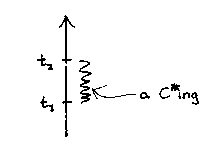
113. Let me rephrase the question. Is there an entity in the world which has the property of lasting from t1 to t2? Consider the following:
This diagram says something which may very well be true. But are C#ings items 'in the world'? Not if our argument to date is correct.
114. We considered earlier (paragraph 71) a sounding which went through several phases: A C#ing, an Ebing, an Fing.
115. What of one unchanging sounding; A C#ing which remains the same and which, we are tempted to say, endures?
116. We can easily be tempted to think of the C#ing as a series of homogeneous phases, each of which begins to be and ceases to be.
117. We are also haunted by Plato's reference to the heracleitean world as the domain of that which always becomes and never is.
118. We are tempted to ask: Is, perhaps, the only item pertaining to our C#ing which exists at any one time an instantaneous C#ing?
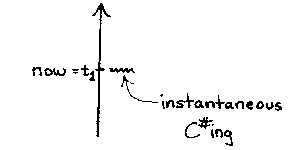
119. Indeed, should we not construe the diagram in paragraph 113 above as a conflation of a continuous series of diagrams?15
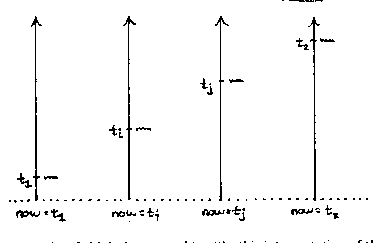
120. Now I think that something like this interpretation of the diagram is correct. It is not, however, as I see it, a perspicuous representation of the ontology of the situation.
121. Instantaneous C#ings are to be construed not as building blocks in the world, but rather as entia rationis tailored to fit the entia rationis which are instants.
122. The underlying truth is that the ongoingness of absolute process requires the idea of continuous coming to be and ceasing to be.
123. But I do not think it correct to equate the continuity of this coming to be and ceasing to be with the mathematical continuity of a continuous series of instantaneous entities -- anymore than I think that the spatial continuity of an expanse of red is to be equated with that of a continuous array of punctiform instances of red.
124. What is required is an account of this continuity which posits neither instantaneous processes nor (pace Whitehead) processes which are entities such that it is a rock bottom ontological truth that they have a finite duration.
125. For, as might have been expected, I would insist on construing sentences of the form
(process) has (duration)
as counterparts at the metalinguistic level of object language sentences involving process verbs and such adverbial modifiers as 'before', 'while', and 'after'.17
126. But the task of doing this for sentences of the form
(process) begins to be
is, as far as I am concerned, music of the future. We can trace it to such sentences as
It begins to C# in the corner
but where do we go from there?
127. What I can do, however, I believe, is to throw some light on the temptation to think of processes as items that in a basic sense have duration -- i.e., that continue to exist for stretches of time, as contrasted with continuously coming to be and ceasing to be in the desiderated sense.
128. This involves an account of the phenomenon of the specious present.18 This account shares features with many other accounts and, in particular, with that offered by C. D. Broad in his reply to his critics.19 My account was developed independently of the latter, though not, of course of his classic formulation in the Examination of McTaggart's Philosophy.
129. The crucial difference between Broad's two accounts is that in the second he abandons the paradoxical view that processes come into existence, so to speak, at the growing end of the future, and then continue to exist from then on, so that the past steadily acquires a greater duration.
130. The gist of the account is represented by the diagram at the end of this chapter. [Inserted at this point. A.C.]
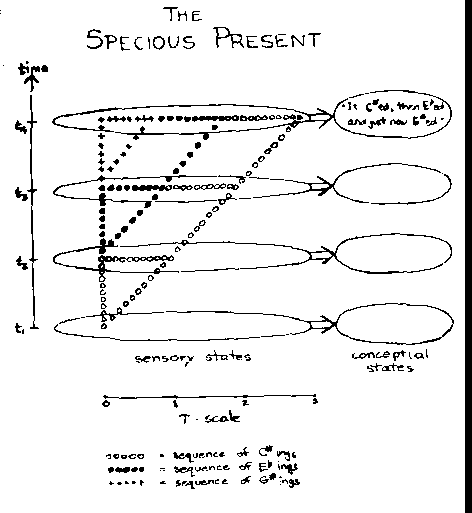
131. In this diagram the large circles (viewed in a perspective) represent instantaneous states of a person qua having sensory states. The vertical dimension represents time. The horizontal dimension represents a unique mode of ordering -- the t-dimension -- of the (temporally) simultaneous constituents of a sensory state (si) of the subject.
132. At t1 a C#ing begins at the zero point in the t-dimension and continues at the zero point until t2, when it is replaced by an Ebing going on to t3 also at the zero point on the t scale, and is then followed by a G#ing which ends at t4.
133. In addition to continuing through the period t1t2 at the t zero point, the C#ing is continued in another manner. Metaphorically it moves to the right in the t-dimension. Thus the t1, t0 stage of C#ing belongs to a sequence of ti, t0 stages (t1 < ti < t2) and to a sequence of ti,tj stages (t1 < ti <; t0 < tj < t1).
134. Indeed, the sequence of ti, tj C#ings which is the t continuation of the C#ing at t1, t0, persists after t2, when the sequence of C#ings at t0 comes to an end and is replaced by a sequence of Eb ings at t0 .
135. For our purposes it is sufficient that the sequence of C#ings in the t-dimension, initiated by the C#ing at t1, t0 persists until t4, at which time there is a C#ing a t4, t3. This is represented by the small circle at the right of stage S4.
136. The same is true, mutatis mutandis, of each moment of C#ing at t0 between t1 and t2. It is the initial stage of a sequence of C#ing stages which moves to the right in the t-dimension. Thus the C#ing at tl.2, t0 continues to the right in the t dimension. At t2 it has reached t0.8
137. Parallel considerations apply to the Ebing from t2 to t3 and the G# ing from t3 to t4.
138. Thus at t4 the subject's sensory state contains a continuous array in the t-dimension of C#ings, Ebings and G#ings. They are temporally simultaneous, but form a sequence in the t-dimension.
139. So much for the ontology of the situation. Let us now look at it from the standpoint of cognitive psychology.
140. The C#ings, whose career in the t-dimension we have been exploring, are nonconceptual states of the subject. Merely as existing they provide the subject with no awareness of a C#ing as a C#ing, let alone as having temporal features. As previously pointed out, a sensing which is a C#ing may be called an "awareness" or a "state of consciousness," but then the latter terms are not being used in a cognitive or epistemic sense.
141. Let us now introduce conceptual acts. Without going into the details of a theory of intentionality, let us simply assume that awarenesses as are functional states which are analogous to spontaneous linguistic episodes (thinkings-out-loud) and which, in accordance with their functional roles, are serving as responses to the items of which they are the awarenesses. In a perceptual context, such an awareness might be represented by
Lo, the red and rectangular facing side of a brick!
142. In the present context, we shall suppose the subject to have the relevant ur-concepts pertaining to the temporal; while, before, after, then, etc.
143. The crucial idea of this theory of the specious present is that at t4 the subject responds to the t-array of C#ings, Ebings and G#ings, by a conceptual act which is a token of the Mentalese expression (for which I use dot quotes);
.It C#ed a while, then Ebed, and just now G#ed.
144. In other words, although the t array as a sensory state is temporally simultaneous, it is responded to by the conceptual representation of a temporal sequence.
145. Just as (or so I have argued) in visual perception we mistake our sensory states for features of physical objects (including our body) i.e., we conceptually rspond to them, for example, with
.This cube of pink ice over there facing me edgewise.so we conceptually respond to what is in point of fact a simultaneous array of sensory states in the t-dimension with
.(Over there in the corner) it C#ed, then Ebed and just now G#ed.
146. Instead of the t-dimension, Broad offers us degrees of 'presentedness'. Others, e.g., C. J. Ducasse, speak of degrees of liveness. These attempts all make the mistake of supposing that the ordering must be one which involves an introspectible (sensory or quasi-sensory) feature. It must, indeed, be a feature of the sensory state that can be responded to. But it needn't be a sensory feature.
147. And, indeed, the concept of the t-dimension is a highly theoretical functional concept (like that of the manifold of sense, itself) and, with respect to how, specifically, t functioning is embodied in the mind, is a promissory note which will ultimately have to be cashed out in neuro-physiological terms.